Harvesting and extracting honey
How to tell when honey is ready, take supers off the hive, extract and store it, and leave enough for the bees.
Taking honey is the end point of a season’s work, and it is also a time when hives are open, honey is exposed and robbing (bees from one colony stealing another’s stores) is a real risk. This guide covers when to take honey, how to remove it from the hive, how to extract it at home and how to keep it. For selling honey, see selling honey.
Before you start
- Choose a fine, dry day.
- Have everything ready first: empty boxes with tight lids, a hive tool, a bee brush, smoker, and a clean, bee-proof room for extracting.
- Plan to finish in one go. Honey and wet equipment left in the open attract robbers.
Step 1: Check that the honey is ready
Bees ripen nectar into honey by fanning off moisture, then seal the cells with a wax cap. A mostly capped frame is generally ready; honey in half-capped frames can still be too wet and may ferment and spoil.
- Pull a frame from the top super and look at both faces.
- Take frames that are mostly capped.
- Leave behind frames with a lot of open, glistening nectar, and let the bees finish them.
Capped honey is a guide, not a guarantee. If you are unsure, ask your local club (see clubs and associations) or an experienced beekeeper to look at a frame with you.
Step 2: Decide how much to leave
Do not take everything. In winter, or any time few flowers are in bloom, the colony lives on its stored honey.
- Leave enough honey for any period when nectar sources are unavailable, especially before winter. How much varies by location, so ask your local club what is usual. Agriculture Victoria’s feeding to prevent starvation page has more on stores.
- Take honey from supers above the brood boxes. Leave the brood boxes and their stores alone.
If a colony is short going into winter, see feeding, water and forage. Season-by-season timing is in seasonal management.
Step 3: Remove the bees from the supers
A super is a box of honey frames above the brood boxes. There are four common ways to clear bees from it, all described by the University of Florida extension service.
| Method | How it works | Notes |
|---|---|---|
| Bee brush | Brush bees off each frame, then put the frame straight into a closed box | Slow; suits one or two supers |
| Escape board | Fits between the supers and the brood boxes; bees can leave the supers but struggle to return | Follow the maker’s instructions for how long to leave it on |
| Leaf blower | Super laid on its side, bees blown off | Mainly used commercially |
| Fume board | A board with a repellent on it drives bees down | Not covered further here; use a repellent only if it is legally allowed for this purpose, and follow its label |
For a first harvest, a brush plus an escape board is the simplest. With an escape board, put it on ahead of time as its instructions say, then come back to collect.
Taking frames off
- Smoke the hive lightly, as for an inspection (see your first inspection).
- Lift a super off, or lift frames out one at a time.
- Brush the bees off gently and put each frame into a lidded box straight away.
- Keep the lid on the box and carry it to the extracting room. Cover any honey boxes you set down.
- Replace the lid on the hive. Work late in the day if robbing is a problem.
Do not leave open boxes or frames near the hives.
Step 4: Extract
Equipment: an uncapping knife or fork, a honey extractor (a drum that spins frames so honey flings out), a strainer or filter, a bucket, and a food-grade container. Clean and dry everything before and after use.
- Uncap. Slice or scratch the wax cappings off both faces of each frame, over a tray or tub that catches the cappings.
- Load the extractor. Balance the frames so the drum spins evenly.
- Spin. Start slowly and build speed. Turn the frames and spin the other face.
- Strain. Run the honey through a strainer into a clean bucket. Let it stand so fine bubbles and wax particles rise.
- Return the wet frames. Give the emptied frames back to the bees to clean, with the lid on and robbing in mind, or store them where bees cannot reach them.
Keep cappings, honey drips and wash water out of reach of the bees.
Step 5: Store the honey
- Use clean, dry, food-grade containers with tight lids.
- Keep honey away from water and humid places.
- Label each batch with the date. Keep a record of which hives and frames it came from.
Clean the extractor, drums and containers after each use, and again before the next, as BeeAware advises. If you plan to sell any honey, labelling and food-safety rules apply; start at selling honey.
Biosecurity: keep honey from spreading disease
American foulbrood (AFB) spores can survive in honey and equipment. A few habits lower the risk:
- Never feed bought honey to bees. Business Queensland advises not to feed bees honey or pollen unless it has been sterilised by gamma radiation. The WA Department of Primary Industries and Regional Development lists feeding supermarket honey, or letting bees rob extraction equipment or exposed honey, as things not to do. Use sugar syrup instead.
- Keep the extracting area bee-tight. Close windows and doors, and seal equipment and waste so bees cannot get in. The Code of Practice requires that honey, used hive parts and honey-containing equipment are not left where robber bees can reach them.
- Dispose of old comb, wax scraps and unwanted honey so bees cannot reach them.
If you see signs of foulbrood while harvesting, such as sunken, dark or perforated cappings, stop and contact your state agriculture department. See American foulbrood.
Harvest checklist
- Fine, dry day; extracting room clean and bee-tight.
- Mostly capped frames only.
- Leave the brood boxes and enough stores for the bees.
- Clear bees with a brush, and an escape board if you can.
- Carry frames in lidded boxes.
- Uncap, spin, strain, then store in clean, sealed containers.
- Clean all equipment; keep wax and honey out of reach of bees.
- Record dates, hives and amounts in your notes (inspections and records).
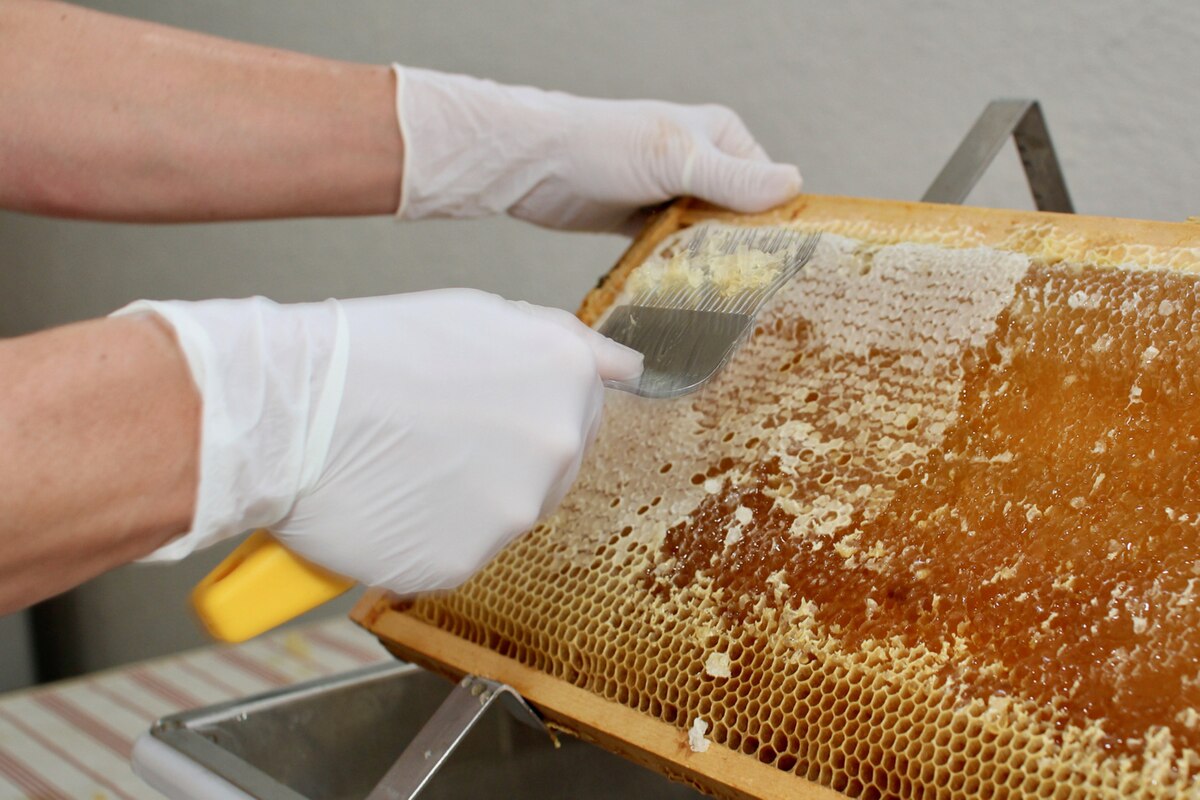

Photo credits
- Uncapping a frame: Dunkle Biene, Wikimedia Commons, CC BY-SA 2.0.
Sources
Every fact on this page was checked against at least two independent sources.
- American foulbroodBusiness QueenslandOfficial
- American foulbrood: declared pestDepartment of Primary Industries and Regional Development (WA)Official
- Protecting hives (Code of Practice)BeeAware (Plant Health Australia)Official
- Keeping honey bees healthyBeeAware (Plant Health Australia)Official
- Honey Harvesting: Honey Out of the HiveUF/IFAS Extension (University of Florida)Research and industry