Your first inspection
A step-by-step guide to opening a hive for the first time: timing, smoke, handling frames, what to look for and how to record it.
The first time a hive is opened can feel daunting. Most of the work is preparation: the right weather, the right gear and a plan for what to check. This guide walks through one inspection from start to finish.
If you have never handled bees, consider doing your first inspection alongside an experienced beekeeper. Local clubs often run supervised hive openings; see clubs and associations.
Choose the day and the time
Bees are easiest to handle when conditions suit them. Look for:
- Fine weather with no strong wind. Avoid wet or cold days.
- Good daylight. Very dull periods are best avoided.
- Bees flying in and out of the entrance, with foragers returning with pollen on their legs.
On hot days, avoid the hottest part of the day. It is hard on you in a bee suit and on the bees, so wait until it is cooler.
Ask the person who supplied your bees (see getting bees) how soon after installation the first look inside is sensible. It depends on the type of colony and on the weather.
Get ready
Put on your protective clothing before you go near the hive (see what you need to start). Check the veil and suit for holes, because bees find small gaps. Take off your gear well away from the hive afterwards.
You will need:
- A hive tool and a smoker with fuel.
- Something to record your observations.
- Water to drink on warm days.
- A plan for what you want to check.
Light the smoker
Smoke calms bees by masking their alarm signal and getting them to feed on honey instead of guarding the entrance. The aim is cool smoke. Hot smoke with sparks and flames makes bees angry.
- Light a small amount of paper, add dry fuel and work the bellows until the fire is well established.
- Pack the fuel firmly, but not so tight that air cannot flow.
- Keep the hot barrel away from your body and legs.
Smokers are a fire risk. Light yours on bare ground or in a fireproof container, keep water nearby, and check your state’s fire rules. Smokers are restricted or banned on Total Fire Ban days in most states and territories.
Approach and open the hive
Move calmly and avoid sudden movements. Stay out of the bees’ flight path, and don’t stand or leave equipment directly in front of the entrance.
- Give a few puffs of smoke at the entrance, so the smoke circulates inside.
- Wait a short while for the smoke to take effect.
- Lift the lid slightly with the hive tool and puff a little smoke under it.
- Remove the lid and set it aside, then use smoke lightly across the tops of the frames. Apply it from the top down, because smoke from below pushes bees upward. Too much smoke excites the bees rather than calming them.
If bees begin to gather on the top bars and fly up at you, the smoke is wearing off. Add a little more.
If the hive has more than one box, set the boxes you remove to the side of the hive, not directly in front of the entrance.
Remove and read the frames
- Free the frame next to the hive wall with the hive tool, then lift it out. Removing an end frame gives you room to work on the others.
- Stand that first frame on end in a safe place, such as an empty box or against the hive.
- Loosen the next frame with the tool before lifting it out.
- Lift each frame straight up by the top bar and hold it over the box, so that anything that falls, including the queen, drops back in.
- Look closely at both faces, and gently shake or brush most of the bees back into the hive so the comb is clear.
- Return frames in their original order and facing the same way, unless you are rearranging them on purpose. Push them together so the spacing is right.
What to look for on each brood frame
You do not need to find the queen. You are checking that the colony is healthy and has what it needs:
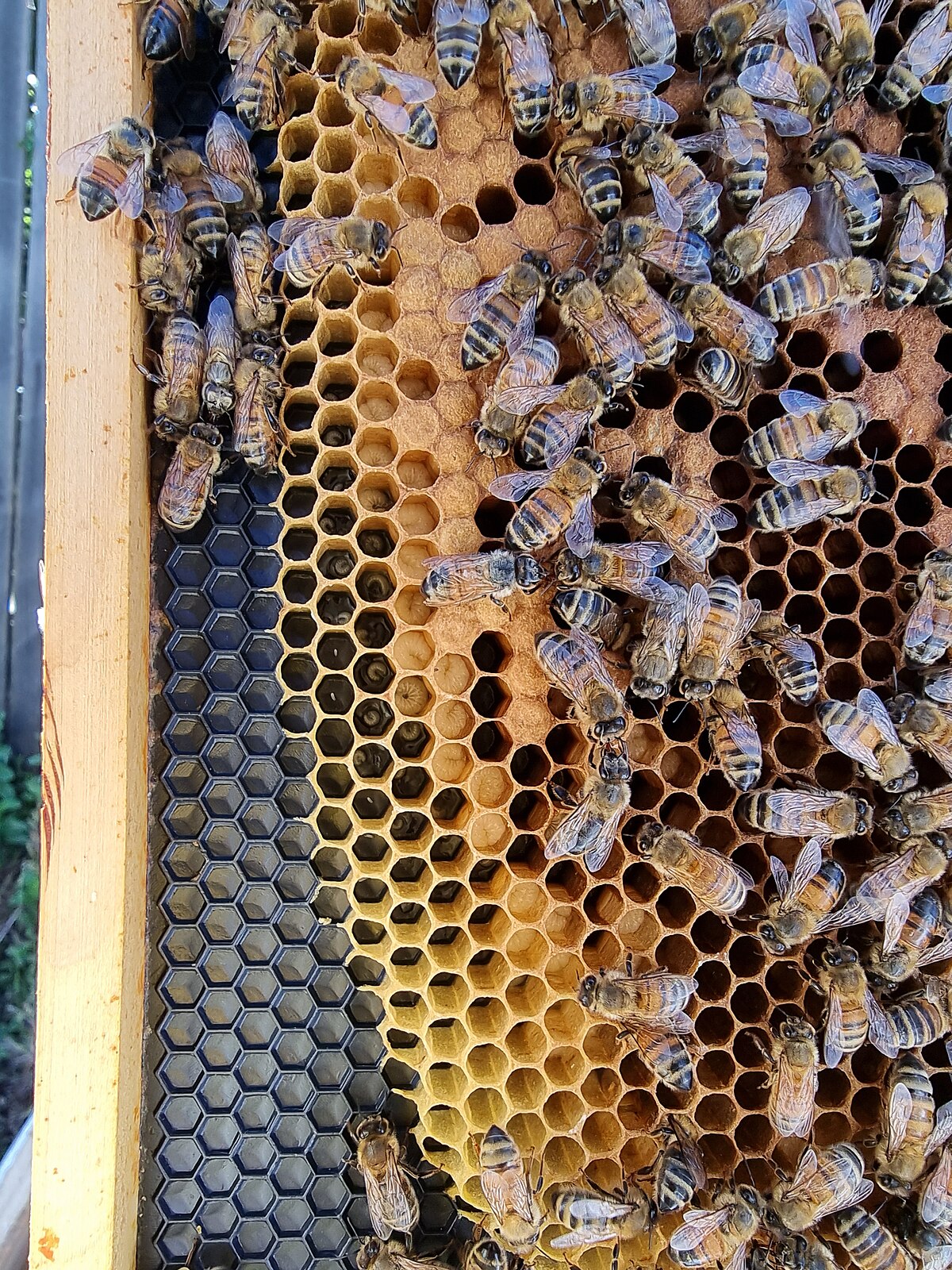
- A laying queen. Look for eggs and very young larvae. Confirming that a queen is laying is a standard part of a spring check.
- A good brood pattern. In a good pattern, nearly all the cells in an area contain brood. A scattered pattern with many empty cells mixed through capped and open cells is a poor one, and is worth investigating.
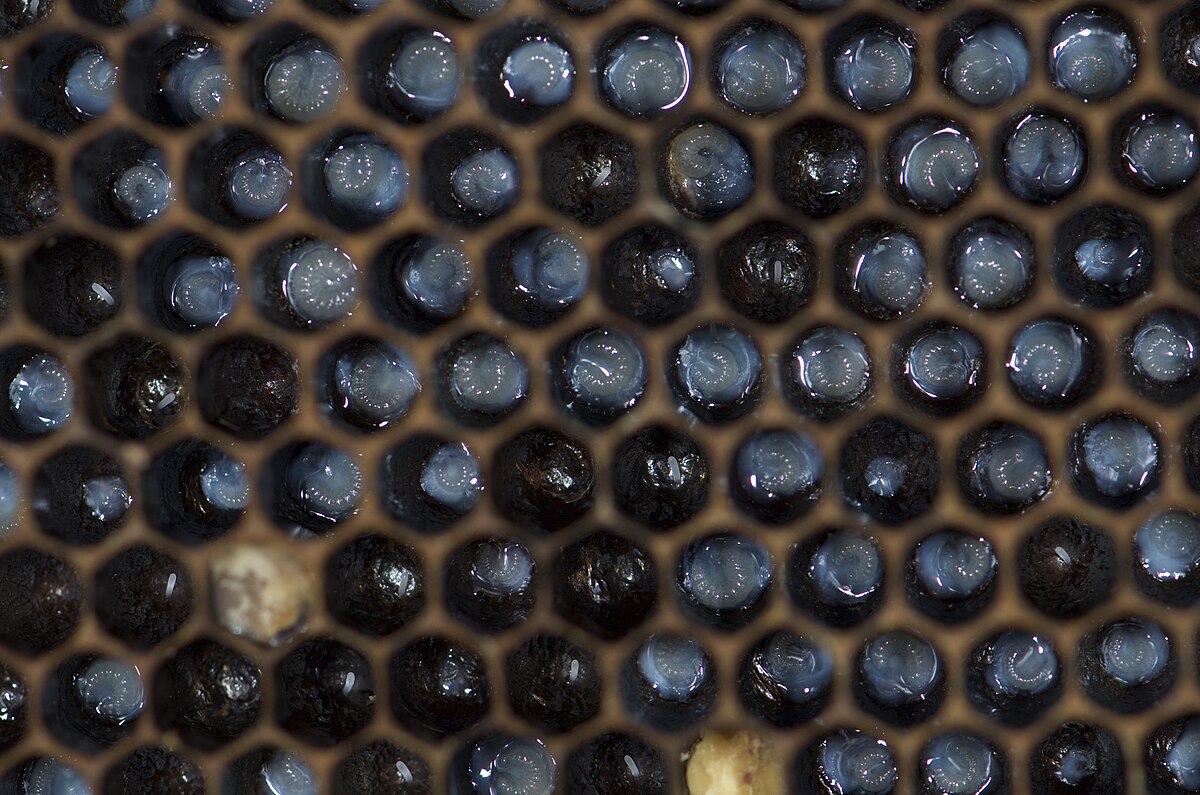
- Capped brood. Caps on healthy brood are an even cream, tan or brown and slightly raised.
- Stores and space. Check how much honey and pollen the colony has, and whether the bees have room to grow.
- Queen cells. Look on the surface and along the lower edge of the combs. Note where they are and how many, as they can signal that the colony is preparing to swarm.

Check for disease and pests
Examining the brood is one of the most important things a beekeeper does, because it is how pests and diseases are caught early. Check at least three brood frames each time.
What healthy brood looks like
Young larvae are glistening, pearly white and curled in the base of the cell. The brood pattern is regular, with no dead larvae or pupae, and the caps have no holes. Pupae under the caps start white and darken as they develop. If you see a perforated cap, look inside to check the bee is developing normally.

Signs to take seriously
- Sunken, dark, greasy-looking or perforated cappings.
- An irregular, patchy brood pattern.
- Larvae that are off-colour (brown) or lying in an unusual position in the cell.
- Dark, hard scales stuck to the lower wall of cells.
These can point to American foulbrood or to other brood problems. A single odd cell is not a diagnosis. See pests, diseases and biosecurity for how to tell the problems apart.
American foulbrood is notifiable in every state and territory. If you suspect it, you must report it to your state or territory agriculture department. Avoid swapping frames or equipment between hives, and ask for advice before moving anything.
Small hive beetle
Adults are small, brown-black beetles about 5 to 7 mm long. They avoid light and run for cover when the hive is opened, so check under the lid and in the corners. Slimy, weeping honey and a rotten smell indicate a serious infestation. BeeAware says small hive beetle is not found in Tasmania or the Northern Territory, and has a very restricted distribution in northern Western Australia. Many states require you to report it, and the rules differ, so check your state’s notification rules.
Varroa mite
Varroa mite was first found near Newcastle, NSW, in June 2022. As at October 2026 it has also been detected in Victoria, Queensland, South Australia and the ACT. Biosecurity Tasmania says Tasmania is still free. The National Varroa Mite Management Program ended on 6 February 2026, and state governments now give local advice. Varroa is notifiable in every state. Include checks for external parasites in routine inspections, and see pests, diseases and biosecurity for current monitoring advice.
Close up and record
Replace boxes and the lid carefully so bees are not squashed. Keep scraps of wax and propolis in a sealed container and take them away, because bees from other hives can rob them and spread disease.
Write your notes straight away. Useful items include:
- The date and the weather.
- How strong the colony is.
- Any pests or diseases, or anything you were unsure about.
- Whether you added or moved boxes and frames.
- Anything you brought in from elsewhere, such as bees or used equipment.
Registered beekeepers should also be familiar with their state’s record-keeping rules; see registering your hives.
How often to inspect
Guidance varies, so ask your state agriculture department or club. As a guide:
| Source | Suggested frequency |
|---|---|
| BeeAware | At least several times a year, during spring, summer and autumn |
| Biosecurity Code of Practice (minimum) | At least twice a year, at least four consecutive calendar months apart, and more often if needed to limit the spread of pests or disease |
Thorough brood checks are also recommended in early spring and in autumn, as hives are prepared for winter.
Stings and calm handling
Anyone who keeps bees will be stung sooner or later. If you know or suspect you are allergic, seek medical advice before you start. If you are stung, remove the sting as quickly as you can by scraping it out with a fingernail edge or a credit card, rather than squeezing it. Anyone who may be having a severe allergic reaction needs emergency help: call triple zero (000).
Most defensive behaviour comes from how the hive is handled: the approach, the way frames are lifted, the amount of smoke, the clothing worn and the time of day. Slow, steady movements help.
If a bee gets inside your veil, stay calm and move well away from the hive before lifting it.
First inspection checklist
- Pick a fine, calm day with bees flying, avoiding the hottest part of the day.
- Put on protective clothing and check it for gaps.
- Light the smoker and aim for cool smoke. Check fire rules first.
- Have your hive tool, notes and water ready.
- Approach calmly, out of the flight path.
- Smoke the entrance, then lightly under and across the lid.
- Remove an end frame first. Loosen each frame before lifting.
- Hold frames over the box and keep them in order.
- Look for eggs, young larvae, brood pattern, stores and queen cells.
- Check at least three brood frames for signs of disease. Look for small hive beetle.
- Return the frames in order and close up carefully so no bees are squashed.
- Take away wax scraps, record your notes and put your gear away safely.
Photo credits
- Brood frame with eggs and larvae: Benlisquare, Wikimedia Commons, CC BY-SA 4.0.
- Healthy larvae and capped brood: Piscisgate, Wikimedia Commons, CC BY-SA 4.0.
Sources
Every fact on this page was checked against at least two independent sources.
- Inspecting hivesBeeAware (Plant Health Australia)Official
- Safe beekeeping practicesAgriculture VictoriaOfficial
- Field diagnosis of honey bee brood diseasesAgriculture VictoriaOfficial
- Notifiable bee pests and diseasesAgriculture VictoriaOfficial
- American foulbroodBusiness QueenslandOfficial
- Small hive beetleBusiness QueenslandOfficial
- Small hive beetleBeeAware (Plant Health Australia)Official
- Pests and diseases in honey beesDepartment of Primary Industries and Regional Development (WA)Official
- American foulbrood diseaseACT GovernmentOfficial
- Inspecting hives (Code of Practice)BeeAware (Plant Health Australia)Official
- Reporting diseasesBeeAware (Plant Health Australia)Official
- Bee and wasp stingsHealthdirect AustraliaOfficial
- Hive inspectionsExtension Australia (Professional Beekeepers)Research and industry
- Spring managementExtension Australia (Professional Beekeepers)Research and industry
- Fire safety for beekeepersExtension Australia (Professional Beekeepers)Research and industry
- Summer managementExtension Australia (Professional Beekeepers)Research and industry